
Project
Funnel Plot Quality Indicators, Institutional Performance Benchmarking, and Publication Bias Assessment: An R-Based Visual Analytics Framework for Cancer Drainage Interventions
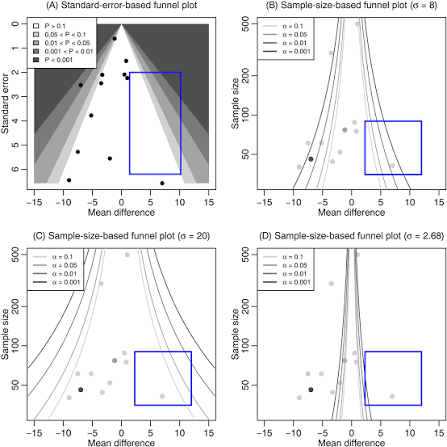
This project constructed an R-based statistical quality control and meta-analytic evaluation framework utilizing funnel plots to analyze clinical outcomes, institutional variability, and evidence synthesis across oncological drainage procedures (such as percutaneous transhepatic biliary drainage, endoscopic ultrasound-guided gallbladder/biliary drainage, and surgical lymphatic drainage). Funnel plots serve as a crucial diagnostic tool in clinical epidemiology, allowing researchers to evaluate institutional performance against national benchmarks while adjusting for sample size variations and extreme value inflation in small-volume centers.Using specialized R packages—including metafor, meta, funnelR, and ggplot2—the analytical pipeline processed procedural success metrics, complication rates, and post-procedural mortality telemetry. For institutional quality audit applications, Spiegelhalter-style control limits were constructed around target mean outcome rates at $95\%$ ($\pm 2\sigma$) pseudo-confidence limits and $99.8\%$ ($\pm 3\sigma$) control thresholds using exact binomial distributions and overdispersion adjustments. This enabled the identification of statistically significant institutional outliers (high or low clinical performance) without penalizing facilities with lower patient volumes.In the context of meta-analytic evidence synthesis, funnel plot asymmetry was rigorously evaluated alongside regression-based diagnostics (Egger’s test and Begg’s rank correlation test) to assess publication bias and small-study effects across published clinical trials. Trim-and-fill procedures were executed in R to impute missing study effect sizes and re-evaluate pooled risk ratios. The resulting visual analytics and quantitative diagnostics provided clinicians and healthcare administrators with robust, reproducible evidence to evaluate procedural safety, detect care delivery variations, and standardize oncological drainage protocols.
Resources