
Project
Quantitative Evaluation of Urban Governance Determinants on Public Health Accessibility: An SPSS Empirical Analysis of Kibera Informal Settlement, Nairobi
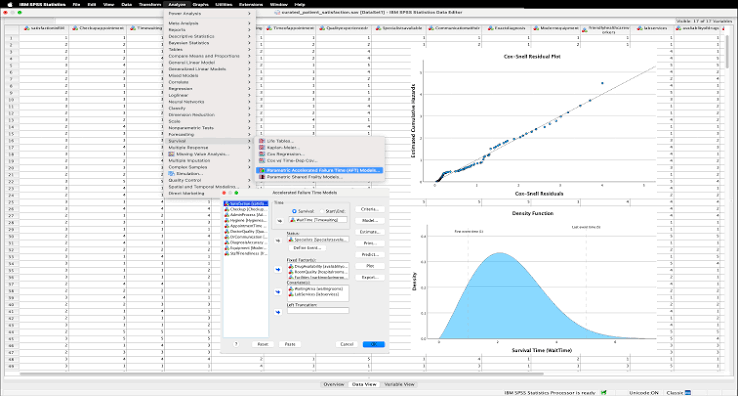
This project delivered comprehensive statistical data analysis and econometric evaluation for Chapters 4 and 5 of a Master’s thesis research project at The Catholic University of Eastern Africa (CUEA) by Simon Owuor (MA in Regional Integration). The empirical study investigates how four core dimensions of urban governance—policy implementation, resource allocation, transparency and accountability mechanisms, and community participation—statistically influence equitable access to public health services within the Kibera informal settlement in Nairobi, Kenya.Using IBM SPSS Statistics, the analysis processed primary survey telemetry collected from a representative sample ($n = 382$ residents) alongside qualitative data from key informant interviews ($n = 20$) and spatial proximity buffers. The data processing pipeline began with rigorous data cleaning, missing value imputation, and Likert-scale variable transformation. Scale internal consistency and construct reliability were validated using Cronbach’s alpha ($\alpha$). Descriptive statistical techniques—including frequency distributions, measure of central tendency (mean scores), dispersion (standard deviation), and cross-tabulations—were generated to map demographic profiles and spatial-access barriers.Inferential statistical modeling was conducted to test the research questions and underlying hypotheses. Parametric assumptions were verified prior to model fitting, including tests for normality, linearity, homoscedasticity, and multicollinearity using Variance Inflation Factor (VIF) metrics. Bivariate correlation analysis (Pearson's $r$ / Spearman's $\rho$) quantified linear relationships between governance indicators and health service accessibility dimensions (geographical proximity, financial affordability, service availability, and care quality). Subsequently, a Multiple Linear Regression model was estimated to quantify the predictive capacity of urban governance pillars on health access equity, identifying key governance bottlenecks such as structural resource misallocation and policy enforcement gaps.In Chapter 5, the statistical output was synthesized into actionable strategic recommendations aligned with Kenya’s Universal Health Coverage (UHC) agenda, East African Community (EAC) regional health integration frameworks, and UN Sustainable Development Goals (SDG 3 and SDG 11). The project established empirical evidence proving that administrative transparency, targeted resource distribution, and non-tokenistic community engagement are critical prerequisites for mitigating health disparities in high-density urban informal settlements.
Resources